
Alpha Schools, self-selection, and willpower
Tethered | May


You’re reading Tethered Letters, a (usually) monthly long-form letter on creative faith and faithful creativity. I also write poetry and I’ve put some in a black book, a few more in a pink book and recently, a bunch in a blue book. Everything I write is AI-free. Thanks for reading.
Hello loved ones,
May was as May usually is, rivalling December in being packed full of good and hard things. As a family of seven, we have a lot of end of school-year events, and they seem to multiply every year. We’ve more-or-less successfully transitioned into a summer schedule, though. The kids are reveling in the shift, plotting many an activity, but mostly just enjoying the ability to do nothing if they so desire. It’s that freedom that really spells summer.
The lupines and bearded tongues frothed up out of the meadow last month in all their glory, and have started in recent weeks to give way to the summer squad — coreopsis, Black-eyed Susans, bergamot. Our garden is finally planted out and has thus far avoided the attentions of our local deer, so I have thus far avoided putting up the rest of the 8-foot high fencing we implement to keep them out. With a few false starts, seeds have germinated and seedlings have transplanted. This year we are trying out birdhouse gourds, onions, watermelon, and five kinds of pumpkins. The gourds are new, but the others have all been failures in past years. But what is a garden for if not for us to keep trying again?
Linnea and her pals hit up an AirBnb nearby for a post-school-year retreat and conference sessions with some of their favorite educators. They had a delightful time together and came back really encouraged. Homeschooling is equal parts difficult and exciting — much like any other type of education, I think. We’re grateful we have the freedom to do it, for all the available wisdom from past generations, and for the steady growth of our kids.
Speaking of education, have you heard about Alpha Schools?
It’s a high-end private school option touted as “the future of school.” It’s been around in some form or another since 2013, and was started by a mortgage broker and her friend, a billionaire investor.1 Alpha commits to three things for students: that they would love school, learn twice as fast as their peers, and learn essential life skills. They’re in six states so far, set to crack the seal on four more in the fall of this year. All of this is possible because they are teacherless and “AI-driven.”2
The lynchpin of their program is that in only 2 hours a day, your child will learn “2X faster,” and (of course) that it’s powered by AI. This is what they claim revolutionizes education. Oh, and they have a homeschool program. So naturally I checked them out, listened to a three-hour interview with Joe “Excitable Billionaire” Liemandt, and read a glorified Yelp review from a parent who flew his kids across the country, apparently to *checks notes* test the school out like his kids are guinea pigs and help him write a good review for a contest?
If what you just read worries you, just wait. It’s even wilder than you think.
The methodology is simple. Using MAP testing as your evaluative goal, create personalized lesson plans for each child, which they pursue at their own pace. Instead of moving them up as they age, they must demonstrate mastery of any foundational knowledge they need to acquire in order to ace the tests, filling in the gaps as you go. The AI tutor not only sets up your curriculum (think glorified spreadsheet more than virtual hand-holding), it offers feedback on how you’re doing. Joe offered a few examples of how this curriculum might take place (not sure if it’s just him riffing, or if these are actually examples): Candy Crush, but multiplication tables. Or a student might get a lesson plan to fill in a history gap that correlates European kings and queens to Taylor Swift’s discography. I don’t know how that latter one works and I’m scared to ask, but those are literally two examples that Joe shared in the podcast.
So right away we see one big component of what makes Alpha tick: gamification.
If you know anything about gamification, you know that it alters brain chemistry and can lead to addictive habits, particularly in pliable younger minds. One might argue that getting kids addicted to “learning” isn’t all that bad. But is that really what they are going to be hungry for when they hit the real world? Apparently, Alpha school grads are being celebrated for achievements like creating an AI dating advice app, accruing millions of TikTok followers, incubating influencers, “writing” and directing a viral Tiktok musical, or designing an AI plushie. Perhaps you sense a trend here.3
Perhaps the question isn’t what students educated in this mode of learning will be hungry for when they hit the real world, but if they will ever experience the real world at all — or just be remarkably adept at building virtual worlds to insulate themselves from it.
Here’s Joe on How Excited He Is about gamification:
“This engine, if I get kids to go through it, is going to provide the learning. And so how do I get engagement? And the people who know how to engage kids more than anybody, is video game developers. They know how to engage kids. Tiktok and video games… We’ve invested over 100 million dollars in getting some of the best video game designers in the world, they’re down in Austin, and they are building a video game on top of the two-hour learning engine that they believe will rival any video game on the planet, and the difference was, parents will be happy with their kids playing it.” (emphasis added)
Joe said this in a conversation about how to scale the product he is selling, the program he calls Timeback, which kids at Alpha schools spend their mornings using to achieve 99th percentile MAP testing results. This is the product he wants to launch outside of Alpha schools, for private schools and homeschool families. Keep in mind that Joe is an investor in privatized education, not an educator. It’s nice that he wants to help kids (like, the ones whose parents can afford a $40,000 tuition fee). But also, he’s convinced that every parent will fork out any amount of money for their kids to love school.
The guy who wrote the review of Alpha schools (the guy with guinea pig kids) is one of those parents, but he reveals some interesting things about Alpha’s methodology.
The rest of the day (after a morning of video game education) is spent “gaining life skills” and “doing hard things,” like running an Airbnb or a food truck, scaling climbing walls or training for 5Ks, coding or e-sports.
The feedback loop is accomplished by literal surveillance, i.e. eye-tracking, click-tracking, and time-keeping. If Johnny doesn’t focus his eyes on that educational Youtube video, they will know.
Alpha is not adult-free, but it could be argued that it is teacherless – because they are paying the adults in the room to be “coaches,” not to teach lessons. Why hire educators when you can pay retired sports coaches six figures to do the job? Sidenote: if the economics of this aren’t making sense to you, don’t worry – Joe says they’re in the cash burning portion of the investment.
Students are paid for meeting learning goals, because why not juice the numbers with a bit of start-up cash? (“Was it bad that they were being bribed to do lessons? 76% of Americans would think so. But it definitely worked… My middle daughter — who is the most driven by money — has completed more than two full grades of school in ~20-weeks (60% of the school year), and shows no signs of slowing down.”) This ends up being about $2 per day (it appears to expand in high school), but they can earn 10 times that amount if they keep doing their lessons during the summer.
Learning speed (efficiency of knowledge-maxxing) is the goal, and it is measured by “Lesson Clock Speed,” how fast they master the content, and “MAP Growth Speed,” how high they score on standardized tests. (“When Alpha says their kids are learning 2.6x faster than kids in traditional schools, what they mean is that Alpha kids are increasing their MAP scores 2.6-times faster than similar kids at traditional schools.”)
This last point is key to understanding what looks like the program’s most attractive asset: the 2-hour learning claim, backed up (supposedly) by MAP scores to prove it. Essentially, Alpha has gamed the system by hacking the “teaching-to-the-test” mentalities already inherent in standardized testing. I know teachers personally who spend nearly half the year preparing their students for these tests, rather than teaching them things. Alpha didn’t invent teaching to the test, it’s just perfected it. Timeback — because the schools are just the start-ups and incubators that prove the product — is a glorified test-prep video game.
By the way, guinea-pig guy’s take on all this? He readily admits that this methodology gives the students no edge on things like writing essays, long-term planning or strategy, public speaking, connecting disparate ideas, or actual breadth and depth of understanding of things like history, psychology, economics, leadership, etc. But never fear:
I am less interested in the philosophy of “what is right” and more interested in “what works.”
Okay.
It must be said that an efficient standardized-test-prep video game with 99th percentile results is genuinely disruptive, and would be welcomed by parents and teachers plagued by standardized testing. Lest you think we are exempt from that plague as a homeschooling family, we’re part of a program that, in exchange for subjecting our kids to standardized testing, offers us a fraction of the funding every public school kid receives to help subsidize our school supplies. I don’t know anyone who likes or appreciates ILearn. So of course, an AI-powered software that will help your kid ace it is an attractive option, particularly if your goal is to get them into an elite college.
GP Guy may not bat an eye if asked to run over a puppy for his kids education, but he hits the nail on the head here:
“For me, the real value that comes from Alpha is not the performance uplift. The most important feature of Alpha is that they have found a way to learn more efficiently. It allows students to condense all the “required” state-mandated material into half a day for ~6 years instead of a full day for ~13 years. Is that the right stuff to learn? Are they learning all they need from that platform? That almost doesn’t matter. The point is that the alternative is to spend more than twice the amount of time to get to the same (or worse) output.”
And if I had $40,000 to burn ($200,000 annually, given I have five kids)... yeah, still wouldn’t do that. But that doesn’t mean I’m not picking up what he’s laying down here.
Questions remain. Where does all the surveillance information go after it is used for feedback? Does the feedback bot use a funny voice? What actually is the goal of an education? What are the consequences of gamifying school? Does getting into an elite college or starting an influencer incubator make you happy, healthy, and good? Is there a boot-leg or open-source version of this yet with the same results but weird discount graphics, and where can I download it?
Joking aside, Timeback and Alpha operate from a set of values that become clear if you read between the lines:
Education and opportunities are for those who can afford them.
You should get paid to learn.
If your kids aren’t loving school, the way you’re doing school is wrong.
An education should be efficient, not deep.
Motivation is a result of your circumstances.
Your circumstances should bend to accommodate your motivation.
What works matters, not what is right.
“The key to your child’s happiness is high standards.” (a direct quote from Excitable Joe)
Your child is a machine designed to upload information and download feedback.
And that last one is the crux of the matter. The culture of Alpha is rife with startup concepts and machine language. You see it everywhere: feedback loops, meeting minimums, progress reports, short bursts, encoding information into long-term memory, time-boxed homework. The children aren’t just being taught by AI, they are treated like AI: something that needs knowledge gaps filled and requires constant monitoring, something we will pour billions of dollars into to make it run more efficiently because if, God forbid, it fails to produce something of value not only can it be scrapped for the newest model, but probably all of us are doomed.
To be clear, this is not the beginning of the mechanization of children in education, of treating them not as whole persons, but as automatons to be coded. It is, however, the perfection of it. Make the machine produce results, now with 2x more efficiency! This is the revelation of what already is, the illumination of the sickness in our souls. With any luck, it will be the final straw for parents fed up with a system rooted in making kids good workers (i.e., good robots). Maybe in the shock of this to our collective system, we’ll begin to invest more in methods of education that help kids be good humans.
But see, the former can be accomplished a lot more easily. Information transfer is one thing. Growth is another. It requires time, effort, thankless (and incentiveless) hours of work to achieve mastery, and dare I say it, it requires friction.
The assumption (unchallenged throughout) is that the best education money can buy will make you a good, happy, successful person. A good school leads to a good college leads to a good job leads to a good life — salvation by education. By increasing your computing capacity, your efficiency, and your ability to make money, you will be okay.
Aren’t you glad this isn’t true?
There are many viable and ethical applications of AI available to us. I don’t think AI will be the death of us all anymore than I do that it will be our salvation. It’s just a tool, with powerful applications across many industries.
But many things are just tools. Hammers, screwdrivers, guns, computers, the printing press… at some point you have to admit that the problem is not the tool itself, but the people using it. This whole Alpha school thing is a terrible idea, but that’s not “AI’s fault.” That’s like saying it’s the hammer’s fault when you hit your thumb, or the internet’s fault when you look up porn. Some tools are easier to misuse, can cause more damage due to their power, or are actually built for evil purposes (infinite scroll comes to mind), and we need to acknowledge that and work toward laws that will promote justice, truth, and goodness in our society. But in focusing on the tool itself, we end up diverting culpability away from the people using it.
I think this might be why social media ended up being such a damaging tool — because it is built to be an amplifier of human nature. Twitter could have been used to share and clarify truth, but we used it to de-contextualize and disembowel truth. Instagram could have been used to uplift beauty, but we used it to make beauty false and unattainable. Facebook could have been used to cultivate relationships, but we used it to commodify community. TikTok could have been used to tell stories, but we used it to numb ourselves into oblivion.
And then we come to Substack, which at the end of the day is still a tool despite the insistence of many that it is an “engine of culture” or the “salvation” of a creative scene. What will we make of it? What are we making of it?
Substack gives us curation of our online experience and intellectual pursuits. It gives us (users/creators/products) the reins. It’s great at unearthing writers and thinkers with similar interests and tastes. You get to see and read the things you prefer, while the things you don’t prefer are hidden by default and by choice. This independence offers us what most social mediums have tried to offer but failed to deliver: the opportunity to control our online environment.
Will we use this tool well, or will we allow it to use us?
In Screwtape Letters, which we are studying together with a group from our church, the eponymous senior devil pounds into Wormwood’s head that tempting the Patient away from the reality toward the unreal is the core of temptation. In one instance, he deals with the “danger” of real pleasures, encouraging his protege to play on the Patient’s vanity to trip him up.
“You should always try to make the patient abandon the people or food or books he really likes in favour of the “best” people, the “right” food, the “important” books. I have known a human defended from strong temptations to social ambition by a still stronger taste for tripe and onions.”
And so it may be when we pull up Substack to read through our daily dose of essays. We uphold the “best” under the guise of excellence, the “right” under the guise of moralism, the “important” under the guise of purpose. Or perhaps, we just float along with our preferred crowd and don’t think about where we are floating to.
If I were to extrapolate out to the future of the platform, this could be the way it devolves: into a series of self-selecting cocoons, fully customized to our minds and hearts, all of us protected from acknowledging our own vanity by our bright ideas and shiny skepticism.
Maybe you, like me, sometimes pride yourself on setting up a reading list that challenges your thinking. That’s just the itch I’m scratching at: if we self-select all of our challenges, are they really challenging?
Scripture says that “iron sharpens iron.” A friend of mine mentioned at breakfast the other day that this sharpening requires the metals to be equally hard, and it creates friction and heat. Growth does not occur in a frictionless environment, and our use of this medium might also have us believing that we need, no — that we deserve a frictionless environment in order to thrive.
Maybe a good way of gauging where we are personally in this devolution is what our interactions are like with normal, uncomfortable, non-writerly people in real life. How many friends do we have who aren’t intellectuals, creative types, or writers? Who do we get coffee with? Who do we avoid? Do we find it difficult to talk with people who don’t share our interests, who haven’t been “in on” the discourse we swim in online? Do we encounter them as intellectual inferiors? We all know our American red-versus-blue political coding by now. But what about coding by intellect or aesthetic? Doesn’t that carry the same danger toward vanity and self-deception?
And the vanity and frictionless thinking aren’t the only troubling outcomes. The medium promotes too much, prompting consumption vs. encouraging delight. The sea of infinite “content” drowns the individual drop of water. And it’s too personal. Any relational interaction is centered around responses to the thoughts and experiences of individual personalities, reader to writer or writer to writer, not actual communal experience. I find myself craving interaction with another human being that isn’t related to something one of us has written.
And finally, it’s too abstract, elevating our internal thought life instead of developing our will to act in the real world. This might be the biggest red flag that’s come up, as I come to terms with just how profoundly my use of online social platforms has diminished my willpower.
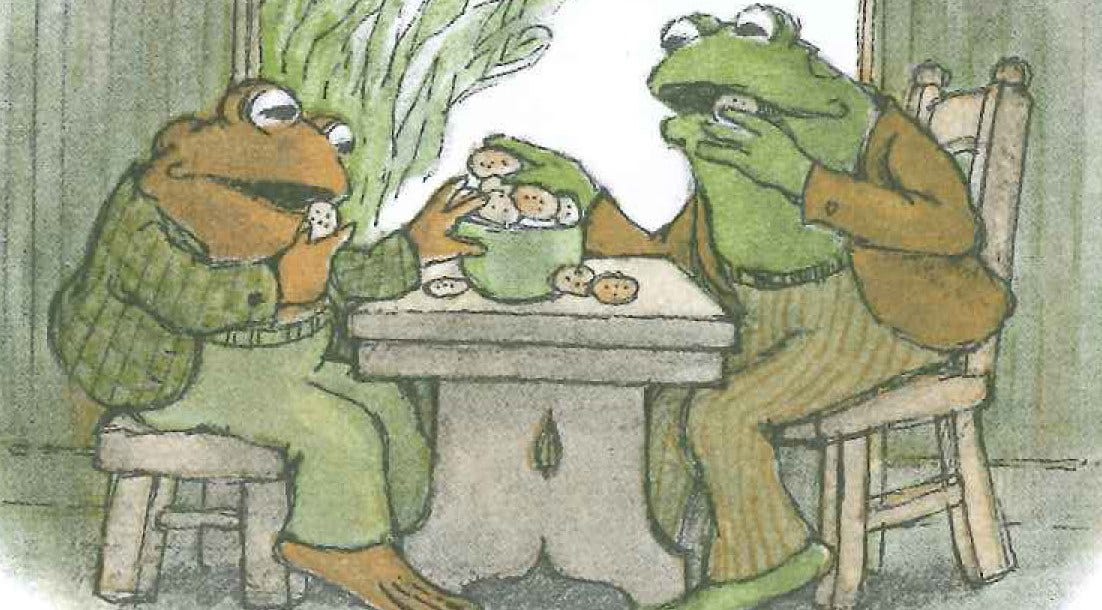
The great temptation of the internet age is to never let our understanding of a thing translate to actual action. Like Frog and Toad scarfing down too many cookies, we lack willpower.
In his 12th letter, we find Screwtape advising Wormwood to make the best of a rotten situation. Wormwood had been attempting to lead the “Patient” down the easy, slothful road to Hell, by taking advantage of his feeling of “dim uneasiness” to tempt him away from God toward distraction and nothingness. It appears he didn’t need technology to do this, just a particular social set: “... just the sort of people we want him to know — rich, smart, superficially intellectual, and brightly skeptical about everything in the world.”
But then, an unexpected snag occurred. The guy went on a walk and read a book (horror!) This became the disastrous occasion for his thoughts to turn to God, which not only shuttled Wormwood out of earshot, but also brought about a healing conviction of sin, forgiveness, and grace. Screwtape moans:
“A repentance and renewal of what the other side call “grace” on the scale which you describe ... amounts to a second conversion – and probably on a deeper level than the first.”
But notice: the instigating factor was something of real, substantive pleasure that turned the Patient’s mind to things of God — literally just a good book the guy liked, and a walk outside.
But all is not yet lost. Screwtape has a plan:
“The great thing is to prevent his doing anything. As long as he does not convert it into action, it does not matter how much he thinks about this new repentance. Let the little brute wallow in it. Let him, if he has any bent that way, write a book about it; that is often an excellent way of sterilising the seeds which the Enemy plants in a human soul.4 Let him do anything but act. No amount of piety in his imagination and affections will harm us if we can keep it out of his will. As one of the humans has said, active habits are strengthened by repetition but passive ones are weakened. The more often he feels without acting, the less he will be able ever to act, and, in the long run, the less he will be able to feel.“ (emphasis added)
This is why a really good book or a walk in the park disrupts the flow of our self-focus — we are doing something real, in the real world, that we really like, with the sort of focus that takes our eyes off of ourselves momentarily. Real life, the sort divorced from the meta-world we inhabit so constantly through our screens, is the antidote, the anti-net. The more we can leave our unrealities and enter into reality, with all its beauty and friction, the more we open ourselves up to God’s work and will.
I experience that beautiful disruption when I get out in the garden. Some days I don’t want to do it. Some days I would rather dissipate at the keyboard, bravely defending my right to keep thinking and feeling and writing about something, instead of doing something.
But I’ll look out the window and remember that I haven’t planted the pumpkins, or I’ll see how long the grass is getting, or I’ll wonder if the pheasantback in our tree row has popped out yet, or my kids will start bugging me to build some LEGOs with them.
Or better yet, I’ll go to church on Sunday.
The local church might be the antithesis of the internet — or rather, it should be. When functioning the way Christ intended, the local church cuts across intellectual boundaries, ethnic lines, class status, gender differences, and political ideologies, precisely because it is rooted in something outside and above all of us: God Himself. In light of Who He Is, as revealed in His Word, we are all of us humbled. Before Him we are reminded of our shared humanity, shared sinfulness, and shared Savior — not of our shared ideas or like-mindedness or personal preferences. The friction in a local church can be astonishing.
Of course, self-selection comes into play in the local church all too often. But so much in any church will be out of our control. We don’t get to control the way the sanctuary is decorated, who sits where, the songs people like to sing, the people who sing them, what the preacher says, how the Word of God exposes our weakness and need, the conviction of sin that comes with it, the move of the Spirit through that conviction. We don’t self-select who gets in the doors (thank God, because Lord knows we don’t deserve to be there ourselves). We are at the mercy of a merciful God, who created and selected us to be loved.
At the heart of self-selection is the idea that I have a right to control my life, live my truth, gamify my education, say whatever I want, massage my narrative... that all of this is mine. That’s a lie too. Nothing I have is mine — from the breath in my lungs, to the brain in my head, to the path my life takes. All of it is God’s, to do with as He wills.
The world says: “You can be limitless and comfortable and controlling and anonymous. You can be what you want to be.”
God says: “You are human, with all the pain and uncertainty that brings, and trying to control things is an illusion. If you became what you wanted to be, you would find it more awful than you can imagine. I see you as you really are, and I love you. Come to me, and you will find rest for your souls.”
The alternative before us is always the reality God calls us into — life with and in an almighty and loving Creator, in company with unlike people who challenge and encourage us, on the beautiful and hard planet He created for us.
Go to church. Read that bedtime story to your kid (for heaven’s sake don’t delegate it to AI). Take the walk. Use physical tools instead of virtual ones. Plant the tomato seedling. Throw the cookies to the birds. Do something that won’t compute. Teach your kids something that takes time and effort, because your relationship with them is more important than how fast it takes or how easy it is to teach it to them. Or better yet, just play with them.
Your life is not online, driven by tools that give you the unlimited ability to indulge in any vice that comes your way. It is out in the real world. And that real world is, despite its difficulty, better than anything the machines have to offer.
May Favorites:
A friend of mine gave me a few back issues of Farming magazine, and it’s just a delight. For those of you who have enjoyed David Kline’s writing and influence on Wendell Berry, he’s on the masthead.
Our summer started out running on a soundtrack of Elvis, the Temptations, and the Supremes. But the album of the month has been Jess Ray’s Mama. Our whole family will be at her upcoming concert in Fort Wayne.
Waffles usually feel fussy so we haven’t done them too often, but we recently found a recipe that doesn’t do that fold in egg whites thing. So, still fussy to run the waffle iron, but one less step between me and waffles. :)
We went and saw Project Hail Mary in theaters. Believe the hype.
I got Malcolm Guite’s Galahad and the Grail for my birthday and I’m reading it aloud to Linnea over the summer (sold out but you can preorder at the link). I would trust no one else with this massive project of versifying the tales of King Arthur. There’s also an audiobook read by the author. Yep.
So stoked for the final season of The Bear.
Also on my birthday, I got a hearty hankering for one of my all-time favorite films, The Emperor’s New Groove.
Nothing to see here.
Nothing to worry about.
This “Alpha grad” Substack, BTW, is absolutely written by AI.
Ouch.